Go to the U of M home page

Pages

Thursday, January 29, 2015

Magna Carta Library Celebration: Feb. 3rd

Magna carta cum aliis antiquis statutis, London, 1540. 
Come join us in the Library lobby next Tuesday, February 3rd, to kick off the anniversary of Magna Carta! To start the 800th anniversary celebration there will be donuts, cookies, granola bars, chips, coffee and (English) tea, starting from 10am and until we run out.

We'll also have two contests for multiple prizes, ranging from Amazon gift cards to food and drink at Republic. Don't forget to pick up some Magna Carta swag as well.

Last but not least, see a historic Magna Carta from the Library's rare book collection.  

Next month, at the end of February, a new exhibit will open in the Riesenfeld Center, devoted to the history and reception of Magna Carta. "Magna Carta, 800 Years: Rights and the Rule of Law," will highlight the rich legacy of Magna Carta in England and America, as seen through the Riesenfeld Center's rare books collection. Stay tuned here for more...

   - Ryan Greenwood, Curator of Rare Books and Special Collections      


Friday, January 16, 2015

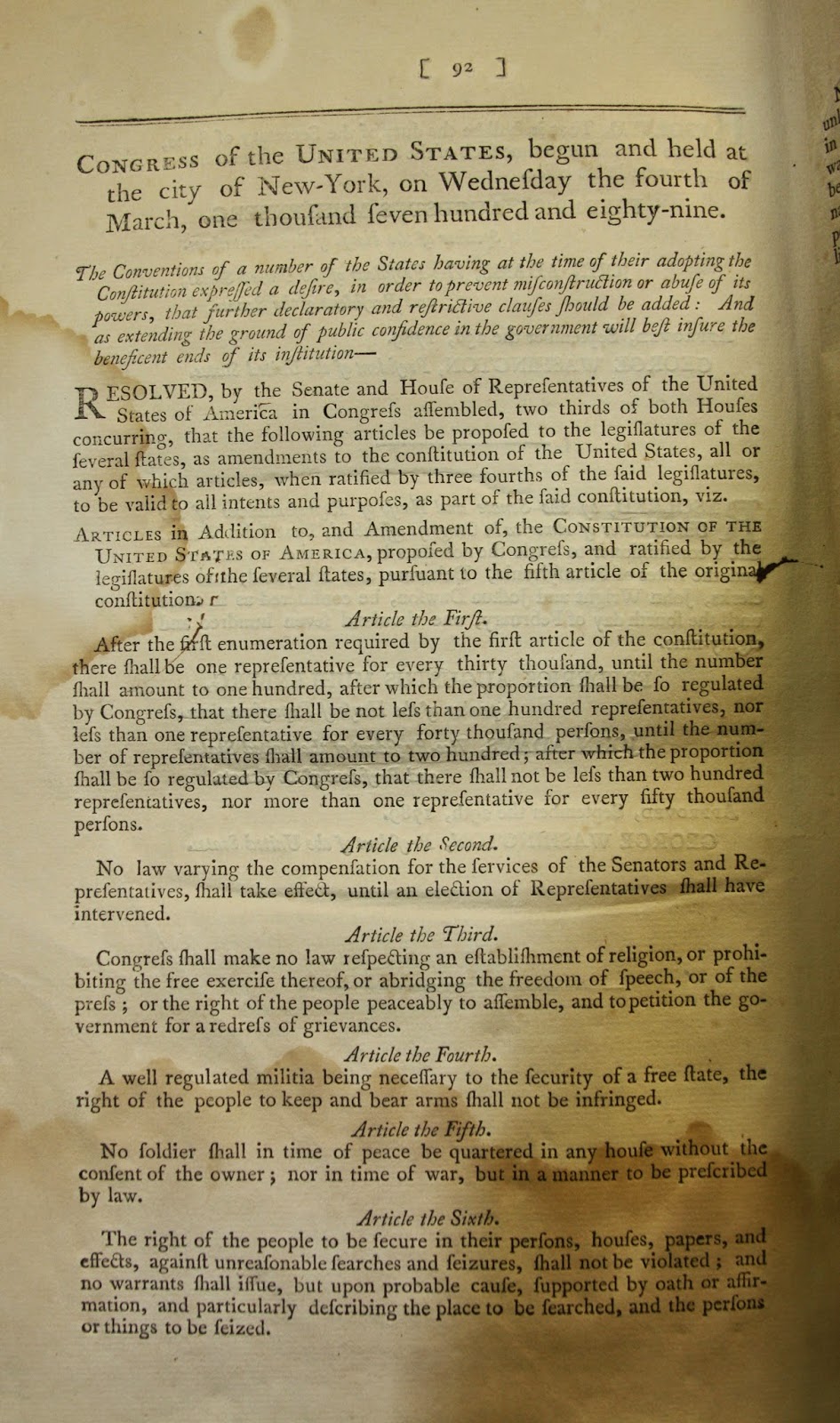
Our Earliest Copy of the Bill of Rights

Acts Passed at a Congress ... New York, 1789/90.
In preparing for our upcoming exhibit on Magna Carta, we had the good opportunity to comb through the Riesenfeld Center's terrific collection of colonial and early US law. Along with the enjoyment that comes in working with this material, the documents can offer up exciting discoveries. One occurred in looking at our earliest, and most significant, copy of the original amendments to the US Constitution, which largely became the Bill of Rights. Our copy, from 1789/90, is found at the end of the first US session laws, issued from the first session of the 1st Congress, held from March 4, 1789 through September. It was at this historic session that the first amendments to the Constitution were introduced, substantially by Madison, following demands for enumerated protections against a potentially overreaching federal government. Debate on the articles continued through the summer, and stirred deeply-held opinion. Twelve amendments were passed by Congress on September 25th. Ten of those amendments were then ratified by three-fourths of the states, and became the Bill of Rights.

Our copy of these extraordinary session laws includes the original twelve amendments, after congressional passage but before ratification by the states. The now neglected "Article the First," concerning proportional representation, sits near the head of the page, and "Article the Second," on congressional compensation, follows it. Unratified at the time, "Article the Second" finally entered the constitutional canon in 1992, as the Twenty-Seventh Amendment. Particularly important for our upcoming exhibit is the Fifth Amendment, which began its life here as the Seventh. This great Amendment has Magna Carta in its direct lineage, as it includes the famous prohibition on the loss of life, liberty or property without due process of law. The Fifth Amendment (and its later partner, the Fourteenth) are still among the most important, and most discussed, amendments in US constitutional law.

Although there were a few earlier printings of early forms of the US Bill of Rights (notably the Gazette of the United States and New York Daily Advertiser carried Madison's original nine proposals in June 1789), our copy of the twelve amendments is quite special and rare, and also interesting for signatures and marks that add to its historical value. One, written at the end of the proposed amendments, toward the bottom of the now dampstained page, is the name "Muhlenberg."  Above the signature is the printed name of the Speaker of the House of Representatives, Frederick A. Muhlenberg, an interesting figure from Pennsylvania. The signature bears some similarities to an authentic autograph preserved online by the University of Pennsylvania. Another signature - that of a Jacob Frost of New York - can be found as well, along with the smaller, neater signature of William Frost. Perhaps Jacob was a son, or at least younger, since his unruly signature and marks look like practice writing.

Does our copy bear the signature of Frederick Muhlenberg, and if so, was he an owner or for some reason simply signed the copy? And who was the Frost family, who seemed to own this copy already in 1789 or 90, and perhaps left it "in the care" of a New York attorney, written as "___iel Sewall" on the back cover? What did this book mean to them, how did they come by it, and how did they use it?  The answers would require a researcher's attention, but they are exciting and challenging. They are also just a few of the questions that can come up when looking at historical books - whether extraordinary or more mundane - with an eye to their particular histories!

   - Ryan Greenwood, Curator of Rare Books and Special Collections
     

Wednesday, December 31, 2014

New Rare Books and Rare Baseball Cards

An Historical View of the English Government cover page
Millar, An Historical View... London, 1787.
The Riesenfeld Center has been very fortunate over the holiday season to receive several wonderful gifts. These include a set of "Supreme Court Sluggers" cards that money cannot buy (at least from the manufacturer), rare books surviving in only a few copies, and an 18th-century indenture that is both decorative and historically interesting.

We are very grateful for Professor David Weissbrodt's donation of an extremely rare first edition of law professor, historian and Enlightenment philosopher John Millar's An Historical View of the English Government (London, 1787), and an expanded edition of the work. The first edition comes in its original boards with untrimmed edges, preserving its historical look, and has the autograph of a likely owner, George Botts, scrawled across the cover in a large hand. Millar was a friend of Adam Smith and professor of law at the University of Glasgow for almost forty years. Professor Weissbrodt also gifted a fine early edition of Millar's most recognized work, The Origin of the Distinction of Ranks (London, 1781). Finally, we received from Weissbrodt a terrific example of a large 18th-century indenture, a contract so-called because of its jagged "teeth," by which it could be reunited (and thus legally validated) with its counterpart documents, forming an original whole.    

John Paul Stevens as catcher on baseball card
Our new "Supreme Court Sluggers" cards also deserve mention. Not unlike the popular Supreme Court bobbleheads (also produced by the Green Bag), the Sluggers feature Supreme Court justices past and present, printed on baseball cards. Each one comes with a quote from a decision included on a stick of "Thought Bubble Gum," and a useful tally of opinions in a stats table on back. As the Green Bag says, "We make no promises about when we will make them or who will get them. Indeed, we are avowedly and aggressively arbitrary and capricious about distribution." Fans of the bobbleheads will know that the rules are similar there. But in that case, to increase the odds of acquiring a bobblehead, the Green Bag offers a quiz -- happy hunting, and Happy Holidays and New Year!

   - Ryan Greenwood, Curator of Rare Books and Special Collections

Thursday, December 11, 2014

Magna Carta is Coming!

Magna Carta title page.
Magna Carta. London: Robert Redman, 1539
Next year is a remarkable anniversary for Magna Carta, one of the great documents and symbols of individual rights, and the rule of law, in the world. The “Great Charter” turns 800 in 2015, and will be commemorated throughout England, America and beyond, for its enduring witness to traditions of fundamental law and constitutional rights. Great celebrations are already underway in England and here in America at the Library of Congress, which has been loaned the Lincoln Cathedral copy of Magna Carta, one of four surviving originals of King John’s charter.
 
At the Law Library we will also host a year-long exhibition devoted to the history and influence of Magna Carta, seen through the wonderful rare books collection at the Riesenfeld Center. At the heart of the exhibit will be the Library’s set of fourteen Magna Cartas printed before 1600, including several associated with notable figures – one that inspired and was owned by great abolitionist Granville Sharp, and one produced by the first woman to print books in England, Elizabeth Pickering.

Stay tuned for more: we will blog about Magna Carta during the year and digitize the exhibit as well. In the meantime, here are some resources for events and exhibits in England and the US, including the Library of Congress exhibition. A final story is on a newly (re)discovered, possibly eye-witness account of Magna Carta, which comes to light just in time for the anniversary: 


   - Ryan Greenwood, Curator of Rare Books and Special Collections

Wednesday, November 19, 2014

Jewels in the Crown: Roman and Canon Law

Bartolo, Commentaria, vol. 1, Venice, 1590.
For centuries, Roman and canon law were the heart of academic legal training on the European continent, and Roman law is at the foundation of civil law codes today. The Center boasts a fine collection of Roman and canon law, including several works first printed in the fifteenth century. These early titles, called incunabula (literally "swaddling clothes"), date from the "infancy" of European movable type printing. Included in our collection are commentaries by illustrious jurists, a number of important collections of consilia (or opinions on particular cases), discrete treatises, court decisions and dictionaries. Shown in the exhibit are a volume of consilia and a great illustration from the renowned medieval jurist Bartolo’s discussion of legal rights.  
    
Sigismondo Loffredo (1480-1539).  Consilia Loffredi.  Venice, 1569.
Bartolo da Sassoferrato (1313-1357).  Commentaria.  Vol. 1.  Venice, 1590.

   - Ryan Greenwood, Curator of Rare Books and Special Collections     


Wednesday, November 12, 2014

Jewels in the Crown: Law and Literature

Bleak House. London, 1853
Law, literature and satire forms a cherished collection at the Library. Many titles can be found in the Barbara Steffens Hedin Alcove on Law, Literature and the Arts, on the second floor. An additional portion is held in the Riesenfeld Center, including those shown in our fall exhibit. Among other titles on display are two legal works owned by and written by the writer Vladimir Nabokov’s father, a jurist and law professor, and a first monograph edition of Dickens's Bleak House. Perhaps Dickens's greatest critique of English law and lawyers, Bleak House centers on an endless litigation in the Court of Chancery, an equity court often accused of inefficiency and mismanagement due to long proceedings. Also displayed are satires like The Pleader's Guide and George Ruggle's Ignoramus (1615). Ruggle's work, extremely successful as a university play, was itself modeled on La trappolaria (1596) of Giambattista della Porta and on Plautus. The difficult law Latin used in contemporary English courts is sent up in some of its popular scenes. In the picture below, the title character Ignoramus stands beneath a lawyer's books and the case of "Proude Buzzard contra Peake Goose."           

George Ruggle (1575-1622).  Ignoramus, comoedia.  London, 1668.
Frank Lockwood (1846-1897).  The Law and Lawyers of Pickwick: A Lecture.  London, 1894.
John Anstey (-1819).  The Pleader’s Guide: A Didactic Poem in Two Parts.  London, 1804.
Vladimir Nabokov (1870-1922).  Sbornik StateÄ­ po Ugolovnomu Pravu.  St. Petersburg, 1904.
Aleksandr Bogdanovskii (1832-1902).  Molodye Prestupniki.  St. Petersburg, 1871.  [with V. Nabokov’s bookplate.]

   - Ryan Greenwood, Curator of Rare Books and Special Collections

Ignoramus, comedia. London, 1668.


Tuesday, November 4, 2014

Jewels in the Crown: Minnesota Law

Bill to Establish ... Washington, D.C., 1848
In time for election day, the Center is a repository for early Minnesota law before and after statehood. Minnesota was given territorial status in 1849, after a bill introduced by Lincoln’s adversary, Stephen A. Douglas (shown at left, with its original green cover).  Minnesota’s Constitutional Convention assembled less than ten years later, though Republicans and Democrats held separate conventions and refused to sign the same document, resulting in two, slightly different versions. The Debates and Proceedings shown in our current exhibit is a Republican account, while the printer of the Journal of the Constitutional Convention, also in the exhibit, is from the “Democrat office.”

Acts, Joint Resolutions and Memorials … of the Territory of Minnesota.  St. Paul, 1850.
A Bill to Establish the Territory of Minesota. Washington, D.C., 1848.
Rules for the Government of the Council of Minnesota Territory … St. Paul, 1849.
Journal of the Constitutional Convention of the Territory of Minnesota … St. Paul, 1857.
Debates and Proceedings of the Constitutional Convention … St. Paul, 1858.

   - Ryan Greenwood, Curator of Rare Books and Special Collections